
By Keri Mitchell
The paradox of the Baptist church in South Dallas called “Cornerstone” is that its original building wasn’t supposed to have a foundation.
Cornerstone’s roots grew out of Second Baptist Church, established in 1888 at Ervay and Corinth. Seventy years later in 1958, Second Baptist moved to the then “suburbs” of East Dallas and became Westglen Baptist Church on Ferguson Road, mirroring the “white flight” of hundreds of other urban churches.
By the early ’60s, Second Baptist’s abandoned building had become the Ervay Street Baptist Center, a community ministry sponsored by the Southern Baptist Convention’s Home Mission Board. Then in the ’80s, the SBC’s decision to end its financial support of urban mission centers shuttered Ervay Street Baptist — but when the SBC walked away, several local Baptist churches showed up.
(Photo: Camilo Diaz Jr., Dallas Free Press)
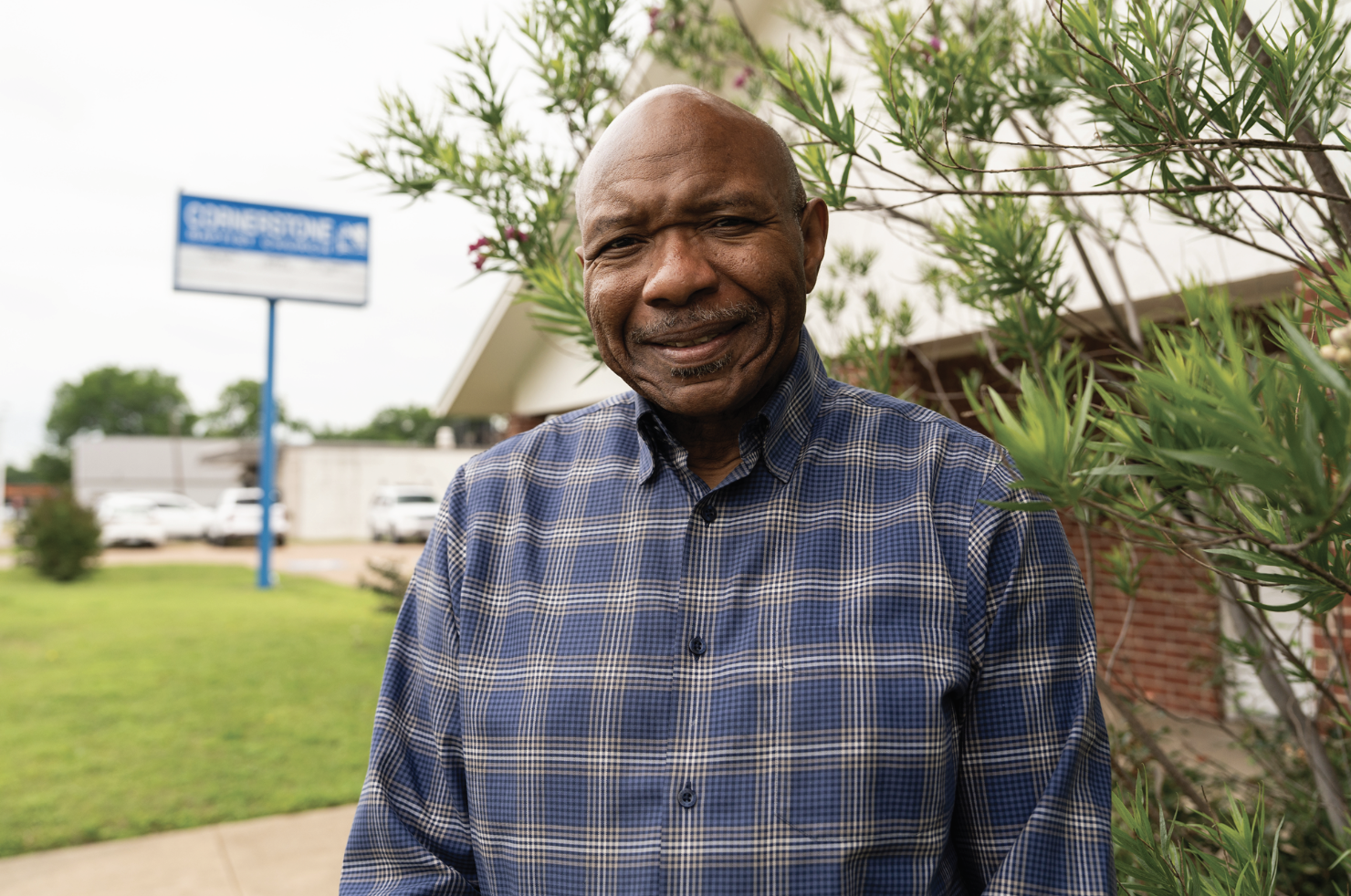
“Wilshire was one of those churches that stepped up to pour into this particular congregation when many people were moving away from inner city work,” says Cornerstone Senior Pastor Chris Simmons, more commonly known in the community as “Pastor Chris.”
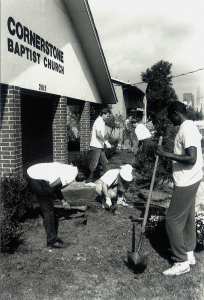
The coalition of churches purchased a property at 2815 Ervay, a few blocks south of the shuttered center, and Wilshire “led the volunteer efforts in the construction of the building,” notes the missions overview in Wilshire’s 35th anniversary booklet published in 1986, the same year Cornerstone Baptist Church opened.
The church was built in a “war zone,” a label conferred by Dallas police and reinforced by media because of the drive-by shootings, the gang activity and the prostitution, as Pastor Chris recalled in a recent interview: “We buried a lot of people in this neighborhood, a lot of young men. Many of the people who could get out of the neighborhood, got out. … It left a lot of urban blight, a lot of vacant apartments that were owned by slum lords in order to continue to cover the drug trade.”
The plan was to build Cornerstone on a pier and beam foundation so that “when the church died, they could move the building and sell the land.” But for some reason — perhaps because the original Cornerstone building sits on toxic soil, says longtime Wilshire member Bob Law — the church was constructed atop a slab foundation. There would be no escape hatch, no future flight.
“Now the church is the largest land owner in the neighborhood, owning some 52 properties in this particular community. God has been just so faithful over these years. We’re able to do a number of outreaches in this neighborhood because of Wilshire really believing in the work here, and not only back then,” said Pastor Chris.
 Pastor Chris paused, overcome with emotion, when talking about Wilshire members Bob and Charlene Law, who began their mission work with Ervay Street in the ’70s even before Simmons arrived on the scene. Bob still frequents Cornerstone Kitchen most Thursdays to serve lunch to the community’s unhoused neighbors.
“My children see them as grandparents. They have been in all of my children’s weddings — I mean, really, really have been friends who have just really been right by our side this entire time.”
He spoke of Tom and Katie Bratcher, who helped shepherd Cornerstone’s preschool program. As Tom worked on the the original building’s baptistry, “some guys broke into the building and literally beat him and left him for dead.” After Tom recovered and was released from the hospital, “the very next day, he was back finishing that particular project.”
“It speaks to the heart of Wilshire’s people who understand the commitment to missions, and the dangers and challenges of missions, but willing to fulfill the task that God has called them to.”
Cornerstone outgrew the original building and now meets in a repurposed grocery store around the corner on Martin Luther King Jr. Boulevard. That original structure now functions as an after school program and is flanked on all sides by the church’s expanding footprint — a kitchen that provides 10,000–15,000 meals a month to the unhoused, clinics for medical and dental care, a maternity home for pregnant women, reentry programs for people transitioning out of incarceration, a community garden and convenience store, affordable housing and more.
“All of that,” Pastor Chris emphasized, “is because Wilshire believed that there was a need for a church in this particular community” 40 years ago, when few believed the church could survive in South Dallas.
“Many churches will parachute in and parachute out. The fact that Wilshire has walked with Cornerstone for many, many, many decades is a testament to the church’s commitment of not just showing up periodically, but really making an investment in the neighborhood.”
• Wilshire member Keri Mitchell is executive director of Dallas Free Press, a nonprofit newsroom focused on South Dallas and West Dallas, which co-published a version of this story and a corresponding video at dallasfreepress.com.